Emily Church
“Working in healthcare has taught me that, at their core, people want to feel heard, treated with kindness, and advocated for.”
Emily is a cardiothoracic nurse based in central London, supporting patients through some of the most vulnerable moments of their lives. Shaped by both personal loss and her own journey into healthcare, she brings a deep sense of empathy to everything she does — grounded in the belief that everyone deserves to feel seen, heard, and advocated for. From women’s health to high-intensity surgical care, Emily has learned the power of speaking up, not just for herself as a woman, but for every patient in her care. Meet Emily. This is her story.
P: Please introduce yourself! Tell us a little about who you are and what you do.
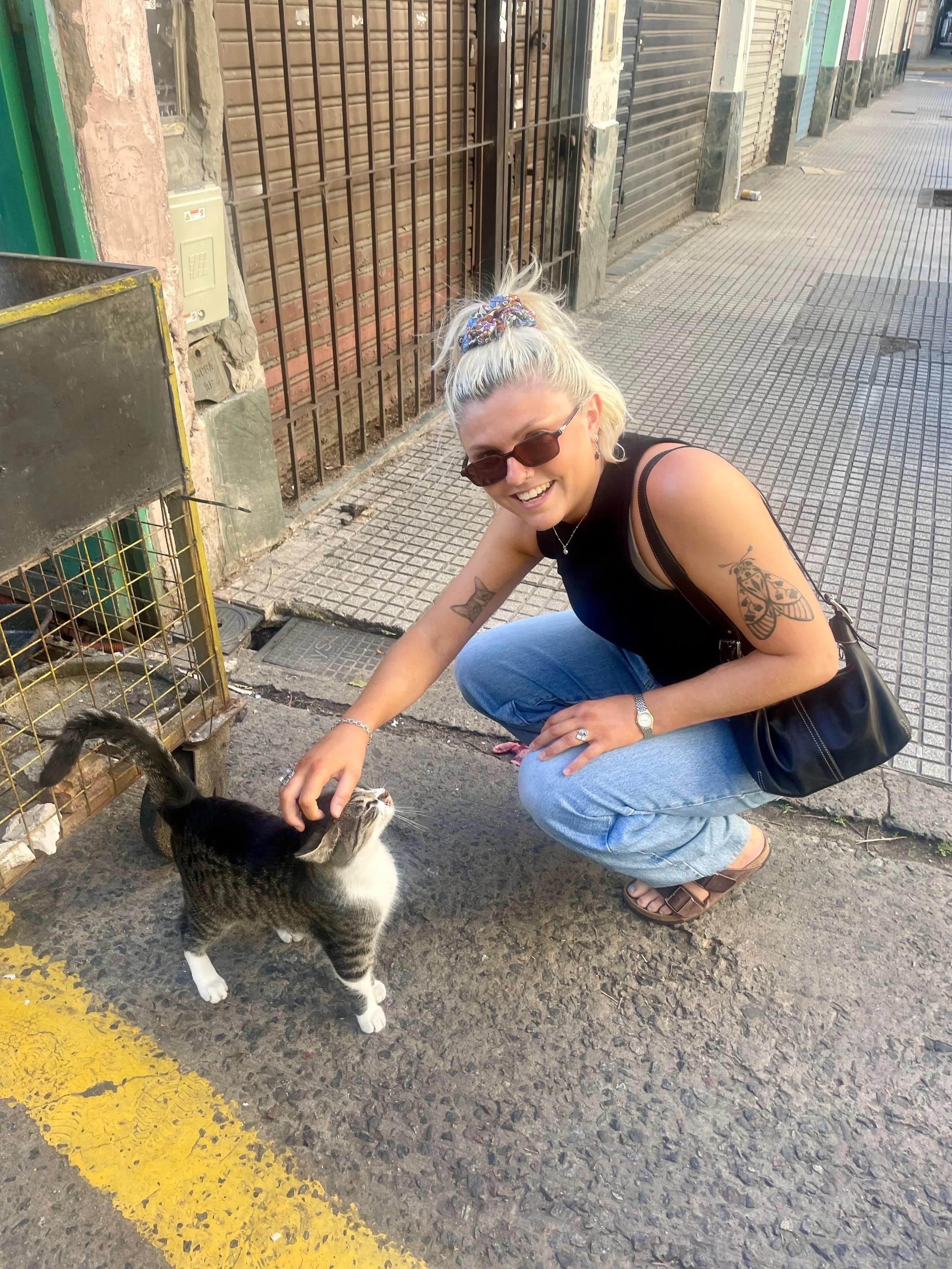
E: Hey! My name’s Emily, I’m 28, and I’m a newly qualified nurse working in a cardiothoracic surgical ward in a central London hospital. On the ward, I look after patients both before and after surgery, supporting them through what is often a really daunting time. Most of my patients are undergoing cardiac procedures, particularly open-heart surgeries, as well as thoracic procedures involving the lungs. It’s a very intense but fulfilling environment to work in. Outside of work, my favourite thing to do is go thrift shopping, or charity shopping as we call it in England. I also really value my quiet time at home, usually just relaxing with my cats.
P: Tell us a story: Has there been a moment in your life that shaped you or made you stronger?
E: A pivotal moment in my life was when I was 18 and I unexpectedly lost a friend of the same age at a music festival. At that age, I don’t think you’re prepared to face something like that, and it forced me to confront the reality of mortality far earlier than I should have. It left me with a lot of anxiety around death and loss, which took time to work through. Looking back now, I think that experience has shaped me in ways I didn’t fully understand at the time. It’s given me a deeper sense of empathy for others and a greater awareness of the fragility of life. It has also made me more appreciative of the ordinary, everyday moments that are easy to take for granted.
P: Did you always know you wanted to become a nurse? What drew you to the profession?
E: I didn’t always know I wanted to become a nurse. My original plan was to become a clinical psychologist. I completed a Bachelor of Science in Psychology from the University of Birmingham and then went on to do a Master’s in Clinical Psychology at Royal Holloway, University of London. After graduating in 2020, I found it really difficult to secure a job due to the pandemic. I ended up applying for a role as a healthcare assistant in an intensive care unit in London, where many of the patients were COVID patients at the time. That experience completely changed my perspective. Being so directly involved in patient care made me realise how much I valued that hands-on, immediate impact, and it ultimately led me towards nursing, even though I didn’t begin my training until a couple of years later.
P: What has working in healthcare taught you about people?
E: Working in healthcare has taught me that, at their core, people want to feel heard, treated with kindness, and advocated for. When patients come into hospital, they are often going through life-changing procedures or treatments and are at their most vulnerable, both physically and emotionally. Taking the time to communicate properly and show compassion can make a huge difference to their experience. It has also shown me just how resilient people are. Even in really difficult circumstances, people find ways to cope and carry on, which is something I don’t think we always give enough credit to.
P: What’s one thing about women’s health you wish every woman knew?
E: Having completed my nursing dissertation on the delayed diagnosis of endometriosis, I wish more people understood how under-researched women’s health still is. Historically, a lot of medical research has been based on male bodies and then applied to women without fully considering the differences in how conditions present. This can lead to delays in diagnosis, poorer health outcomes, and increased risks of complications. It’s frustrating, but it also highlights how important it is for women to advocate for themselves within healthcare, even though that shouldn’t always have to be the case.
P: Has your experience as a woman shaped the way you approach your work?
E: I think being a woman definitely shapes how I approach my work. Many of us are used to not being taken seriously at times, whether that’s being called pet names, talked down to, or having things unnecessarily explained to us. Because of that, I make a conscious effort to carry myself with confidence at work, to be addressed properly, and to be spoken to as an equal. It also makes me more aware of how I communicate with patients. I want them to feel respected and listened to, regardless of who they are.
P: How has your experience as a nurse shaped the way you live your life?
E: Being a nurse has shaped the way I live my life in quite a few ways. My training has made me more aware of important issues like antibiotic resistance, which is a growing problem but doesn’t seem to get as much attention as it should. It has also shifted my perspective on health more generally. I’ve come to value the more basic, “boring” aspects of staying well, like getting enough sleep, managing stress, and listening to my body, rather than feeling like I always need to be doing something intense or extreme. It’s made me realise that being kind to myself is imperative.
P: What’s one thing you wish more people understood about nurses?
E: I wish more people understood just how much knowledge and skill is involved in modern nursing. The level of understanding required in areas like pathophysiology, pharmacology, and clinical decision-making is significant, and the role continues to evolve. It’s not just about carrying out tasks, it’s about critical thinking, responsibility, and being able to respond quickly in complex situations.
What does being a woman mean to you?
E: Being a woman means a great deal to me, and it’s something I take a lot of pride in. It has taught me that in a world which often tries to make women smaller, whether that’s physically or in terms of our voice, we are allowed to take up space. We deserve the roles we hold and the opportunities we’re given, and we bring real value to them. Historically, women have had to fight to be seen and heard in a way that men simply haven’t. Figures like Emmeline Pankhurst and the suffragettes risked their lives to secure basic rights, and there are many examples of women’s contributions, particularly in science, being overlooked or credited to men, such as Rosalind Franklin. Because of this, I think women often grow up having to recognise and prove their value, rather than assuming it will already be acknowledged. That process builds resilience, empathy, and a strong sense of self. As women, we carry those qualities, along with kindness, expertise, and a sense of camaraderie, into almost everything we do, and that’s something I truly respect and identify with.